X-Ray Inspection Systems
Key Points
X-ray inspection makes a lot more sense when you connect it directly to the periodic table. At its core, an industrial X-ray system is measuring how strongly different materials attenuate (weaken) X-rays, and atomic number is one of the biggest factors controlling that.
The basic relationship
Every element has an atomic number, Z, which is the number of protons in its nucleus:
H = 1 → C = 6 → O = 8 → Al = 13 → Fe = 26 → Cu = 29 → Pb = 82
Generally, as you move toward higher atomic-number elements, they interact more strongly with X-rays.
So you can think of an X-ray inspection system as being sensitive to three major things:
Atomic composition + density + thickness → X-ray attenuation
The detector isn't literally saying, "that's iron." It's measuring how many X-ray photons make it through each part of the product.
The factors that lead to this value, are
- X-ray intensity entering the product
- intensity reaching the detector
- thickness of material
- attenuation coefficient
The attenuation coefficient depends heavily on the material's elemental composition and the X-ray energy.
Now put that onto the periodic table
Imagine moving from left/top toward the heavier elements.
This explains something extremely important about food X-ray inspection.
Most food is overwhelmingly composed of relatively light elements:
H, C, N, O
Those are atomic numbers 1, 6, 7 and 8.
But many contaminants contain substantially heavier elements.
Example: piece of steel in a chicken breast
Chicken is mostly water, protein and fat — dominated by:
H, C, N, O
A stainless-steel fragment contains substantial:
Fe (26), Cr (24), Ni (28)
The chicken allows considerably more X-ray radiation through than the metal fragment.
The detector therefore sees something like:
product → relatively high transmission
steel → very low transmission
That difference creates the contrast used by the inspection algorithm to identify the contaminant.
This also explains why X-ray can detect things a metal detector cannot
This is one of the most useful periodic-table concepts when explaining X-ray to a customer.
A metal detector responds to electromagnetic properties such as conductivity and magnetic permeability.
An X-ray system doesn't care whether something is "metal."
It cares about X-ray attenuation.
That's why X-ray inspection can potentially find:
glass, stone, bone, ceramic, metal and other sufficiently dense/high-attenuation materials.
For example, calcium is only Z = 20, but bone contains calcium-rich mineral — primarily hydroxyapatite — making sufficiently calcified bone much more X-ray-visible than surrounding meat.
Glass is another interesting case. Glass isn't metallic, but common glass contains elements such as silicon, sodium and calcium and has substantially greater density than many foods.
So:
Metal detector: "Does this material have electromagnetic properties different from the product?"
X-ray: "Does this region attenuate X-rays differently from the surrounding product?"
That's a major distinction.
But atomic number isn't the whole story
This is where industrial X-ray inspection gets more interesting.
Suppose you have:
1 mm steel
versus
100 mm of dense product.
The X-ray doesn't simply compare steel's atomic number against the food's atomic number. It sees the total attenuation along the beam path.
So inspection capability depends on:
Composition + Density + Thickness + X-ray Energy
That's why a contaminant buried in a thick, dense product can be harder to detect than the exact same contaminant in a thin, low-density product.
For example, X-raying a bag of potato chips is fundamentally easier from an attenuation standpoint than looking through a very thick block of cheese.
The deeper connection between X-rays and the periodic table comes down to how X-rays interact with the atoms inside a material.
There are two especially important interactions in industrial X-ray inspection: the photoelectric effect and Compton scattering.
The photoelectric effect
Think of an X-ray as carrying a packet of energy called a photon. When that photon encounters an atom, it can be completely absorbed by the atom. The energy from the X-ray then knocks one of the atom's electrons out.
The important part for X-ray inspection is that this interaction becomes much more likely with elements that have higher atomic numbers.
So compare:
Carbon — atomic number 6
Calcium — atomic number 20
Iron — atomic number 26
Lead — atomic number 82
As you move toward heavier elements, their ability to absorb X-rays through the photoelectric effect generally increases very strongly.
That's why something containing iron can stand out dramatically against a food product primarily made from hydrogen, carbon, nitrogen and oxygen.
Compton scattering
Compton scattering is different.
Instead of the X-ray being completely absorbed, the X-ray strikes an electron and bounces off in another direction, losing some of its energy in the process.
Think of it like a cue ball hitting another ball on a pool table. The incoming X-ray changes direction and transfers some of its energy to the electron.
Compton scattering is influenced more by the number and density of electrons in the material than by atomic number alone.
Why both matter in an X-ray machine
When an X-ray beam passes through a package of food, thousands or millions of these interactions are occurring.
Some X-rays pass straight through.
Some are absorbed.
Some are scattered.
The detector underneath the product measures how much of the original X-ray beam reaches it.
That creates the image.
If you have chicken with a small piece of stainless steel inside it, the chicken and steel interact with the X-rays very differently. The steel removes substantially more X-ray energy from the beam, so fewer X-rays reach the detector behind that location.
The machine sees that difference as contrast.
X-ray energy matters too
This is also why the energy setting of an industrial X-ray machine matters.
Lower-energy X-rays tend to produce stronger differences between materials because the photoelectric effect plays a larger role.
Higher-energy X-rays penetrate materials more easily, but the relative importance of Compton scattering increases.
So you don't necessarily want to say:
"More X-ray power = better detection."
You actually want enough penetration to get through the product while maintaining enough contrast to distinguish the contaminant from the product.
For example, if you're inspecting a thick, dense product, you may need greater penetration. But increasing the energy too much can sometimes reduce the material contrast you're trying to see.
The easiest way to remember it
Think of industrial X-ray inspection as asking:
"How differently does this object interact with X-rays compared with everything surrounding it?"
The periodic table helps explain why that difference exists.
Food is mostly composed of lighter elements such as hydrogen, carbon, nitrogen and oxygen. Many contaminants contain heavier elements or occur in denser structures—such as calcium-rich bone, glass, stone, iron, stainless steel, copper and other metals.
The bigger the difference in X-ray attenuation between the contaminant and the product surrounding it, the more contrast the detector has to work with and, generally, the easier the contaminant is to detect.
That's really the central physics behind an industrial food X-ray system.
The easiest way to visualise an industrial X-ray system
Think of the periodic table as creating an approximate X-ray visibility gradient:
H → C → O → Al → Ca → Fe → Cu → Sn → W → Pb
Low attenuation ─────────────────────────→ High attenuation
Then put the product on top of that scale.
A food product dominated by H/C/N/O sits toward the low end.
A piece of stainless steel containing Fe/Cr/Ni sits much farther toward the high end.
A piece of calcium-rich bone sits somewhere between them.
The greater the attenuation contrast between the contaminant and the surrounding product, the easier it generally becomes for the X-ray system to detect it.
For industrial inspection, that's the periodic-table connection to focus on: X-ray isn't fundamentally a "metal detector with a picture." It's a measurement of how matter interacts with radiation, and the elemental composition of that matter is a major reason different contaminants become visible.
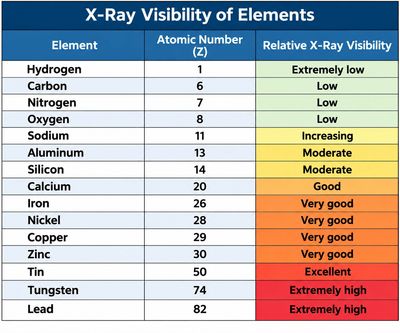
X Ray Visibility of Elements